Best Emergency Kit for RV: Gear Checklist & Power Solutions

Photo by Karson Chan on Unsplash
Best Emergency Kit for RV: Gear Checklist & Power Solutions
An RV emergency kit isn’t one-size-fits-all—it depends on how far you travel from civilization, how long you stay off-grid, and what systems your rig relies on. This guide covers five categories of gear: power backup, communication, medical supplies, tools, and shelter. We’ll focus on equipment that solves real problems—dead batteries, fuel shortages, water contamination, and weather events—rather than items that look good but sit unused.
Why RVs Need a Dedicated Emergency Kit
RVs are self-contained homes on wheels, which means a breakdown or power loss hits harder than it would in a stationary house. You lose refrigeration, water pumps, heating, and climate control simultaneously. Cell service disappears in remote areas. Towing costs can run into four figures. A properly stocked emergency kit keeps you safe, fed, and warm while you wait for help or self-rescue.
The biggest mistake RV owners make is assuming their home emergency kit will suffice. RVs have specific failure modes—propane leaks, freshwater tank freezes, battery discharge, alternator failure—that require different tools and supplies than a house-based emergency scenario.
Power and Charging Essentials
Portable Power Station vs. Generator
A portable power station (battery-based) and a backup generator serve different purposes in an RV:
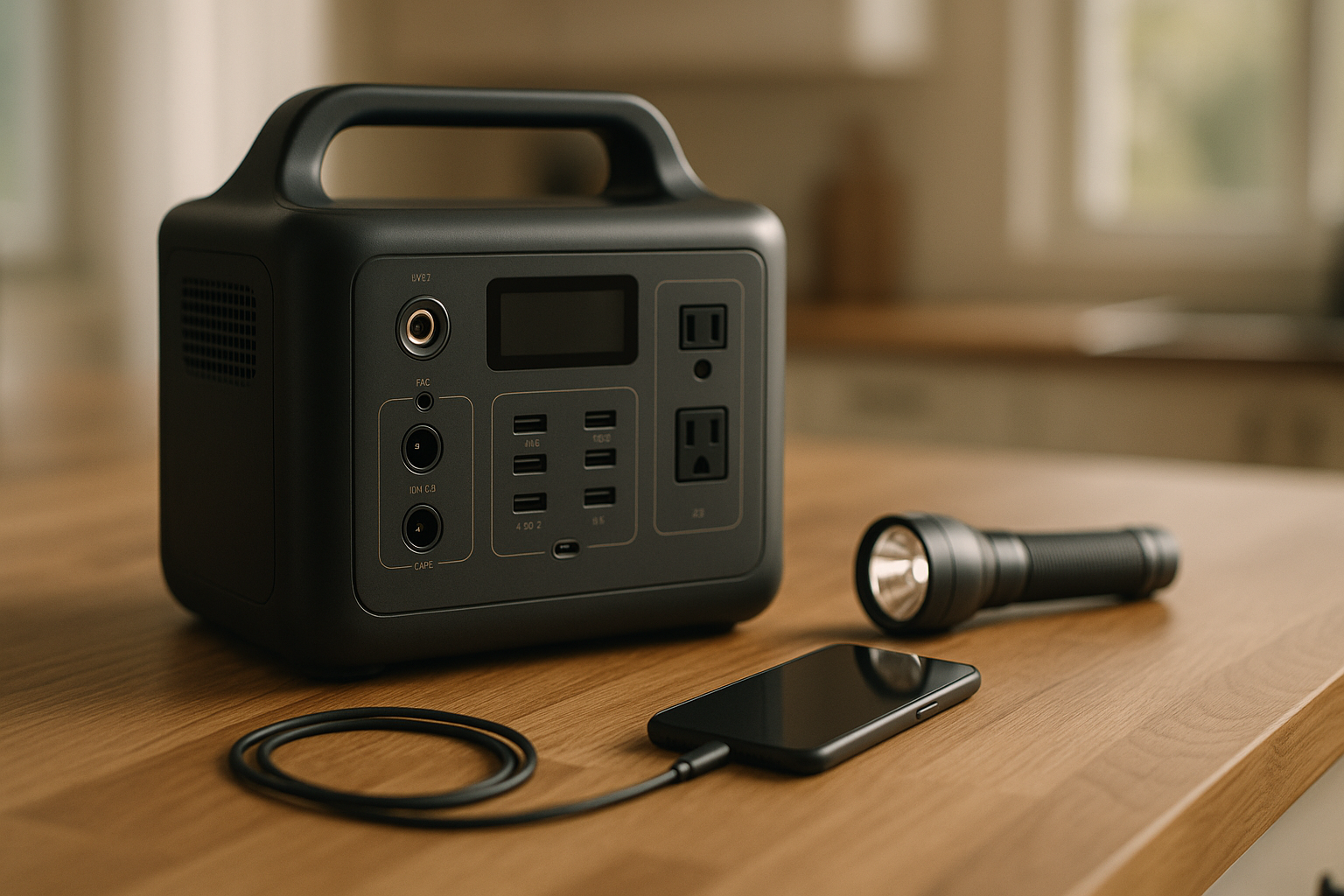
Portable Power Station (silent, no fuel smell, instant power): - Runs laptops, phones, CPAP machines, and small appliances without noise or emissions. - No fuel storage headaches; charges via 120V shore power, solar panels, or your RV’s alternator. - Ideal for boondocking, campgrounds with quiet hours, and overnight emergencies. - Mid-to-premium tier units (500–2000Wh) handle 8–24 hours of essential loads. Example: a 1000Wh station runs a 100W load (laptop, small refrigerator) for approximately 10 hours.
Generator (louder, fuel-dependent, unlimited runtime): - Powers large AC units, water heaters, and multiple high-draw appliances simultaneously. - Requires fuel storage and regular maintenance; not ideal for silent campgrounds. - Better for extended off-grid stays where you need constant, heavy power.
For most RV emergency kits, start with a portable power station in the 500–1000Wh range, then add a quiet generator if you frequently boondock for 7+ days or run air conditioning.
See our full comparison of 1000Wh+ models for boondocking scenarios in Best Portable Power Stations for RVs and Camping 2026.
Solar Panel Backup
A portable solar panel array (100–400W) paired with your power station eliminates fuel dependency on multi-day trips. A 200W solar array can recharge a 1000Wh power station in 5–8 hours on a sunny day, assuming 4–5 peak sun hours typical of mid-latitude locations during summer months. Solar output varies significantly by latitude and season; use a solar calculator tool to estimate charging time for your specific travel region.
Best Portable Solar Panels for Camping: Reviews and Comparison
Battery Cables and Jump-Start Kit
RV chassis batteries can fail suddenly, especially in cold weather. Keep: - Heavy-duty jumper cables (4-gauge or thicker) rated for your RV’s engine size. - A portable jump starter (12V lithium model) that doesn’t require a second vehicle. - Battery terminal cleaner to prevent corrosion-induced power loss.
Per long-running RV forums and owner reports, a lithium jump starter is more reliable than traditional jumper cables for emergency starts, especially in remote areas where another vehicle may not be nearby.
Mechanical and Repair Tools
Essential Breakdown Tools
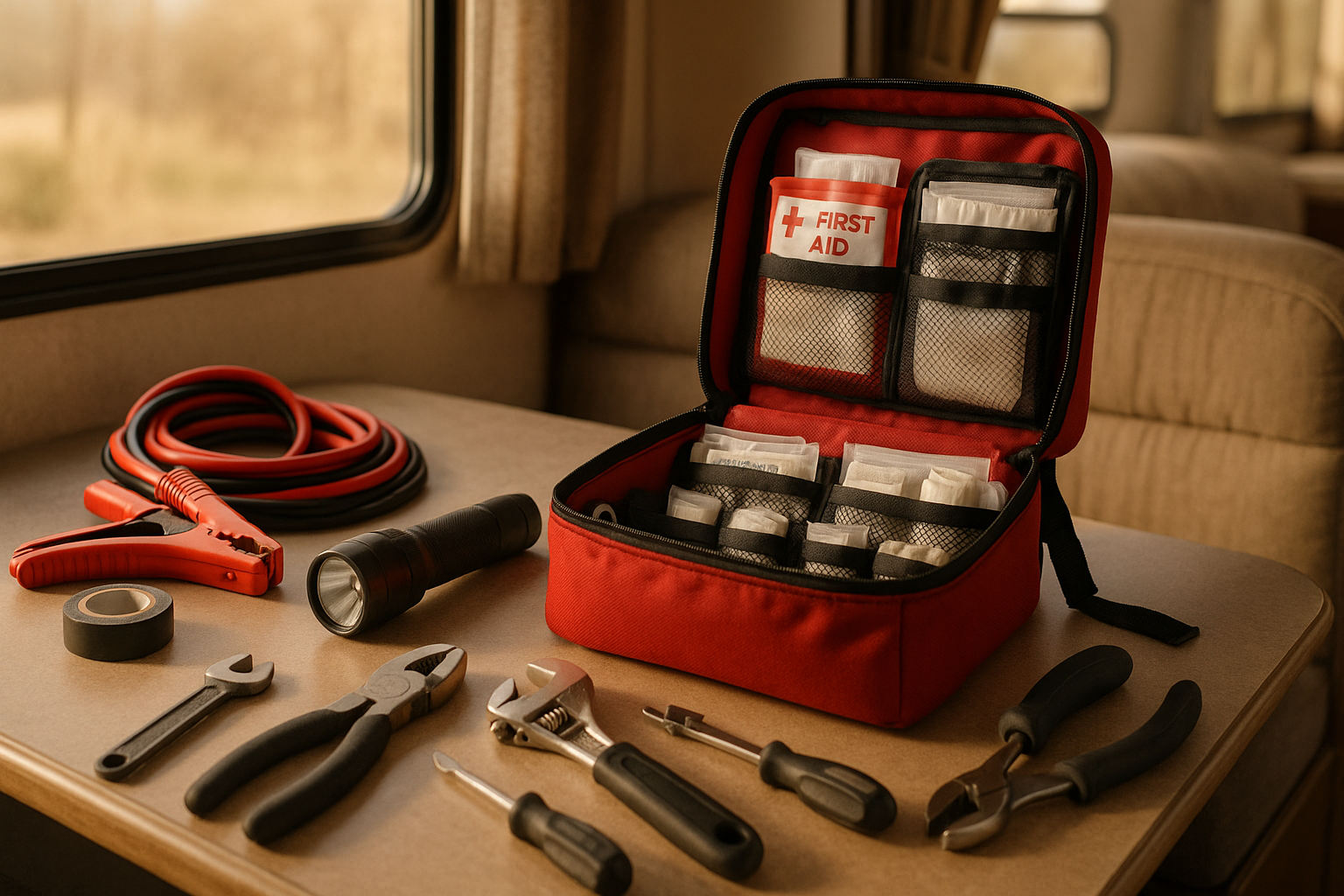
Store these in a weatherproof toolbox: - Socket set (1/4” and 3/8” drives) covering common fastener sizes. - Adjustable wrenches, screwdrivers (Phillips and flat), and pliers. - Tire plug kit and portable air compressor (12V or manual). - Hose clamps, duct tape, and Gorilla tape for temporary seals. - Spare fuses, relays, and wiring connectors matching your RV’s electrical system. - Multipurpose lubricant (WD-40 equivalent) and penetrating oil for stuck bolts.
According to multiple owner reports on RV-specific forums like r/RVLiving, a tire plug kit and 12V compressor have prevented roadside tows more often than any other single tool—tire punctures are the most common RV breakdown.
Propane and Water System Supplies
- Propane leak detector (electronic or soap solution).
- Water filter cartridges for your RV’s freshwater system.
- Pipe insulation tape for freeze protection (install before winter travel to prevent tank rupture).
- Spare water hose and connectors (full-size and quick-disconnect).
Communication and Navigation
Backup Communication
Cell service fails in canyons, deserts, and remote mountains. Carry: - A satellite messenger device like a Garmin InReach or SPOT device for true off-grid SOS capability. - A dual-band mobile radio (VHF/UHF) to monitor emergency frequencies and communicate with other RVers. - Paper maps of your planned route and surrounding regions—GPS fails when batteries die. - A whistle and signal mirror for visible-range emergencies.
Navigation Redundancy
- Offline maps downloaded to your phone or tablet (apps like Gaia GPS or OnX Maps work without cell service).
- A compass and basic map-reading knowledge.
- Your RV’s GPS unit should have offline map capability; verify this before departure.
Medical and First Aid
Core First Aid Kit
- Prescription medications (30-day supply minimum, ideally 90 days).
- Over-the-counter pain relievers, antacids, antihistamines, and anti-diarrheal tablets.
- Antibiotic ointment, hydrocortisone cream, and antifungal powder.
- Sterile gauze, adhesive bandages, and elastic wrap for sprains.
- Tweezers, scissors, and a thermometer.
- Triangular bandage and elastic bandage for immobilization.
- Antibiotic and pain-relief medications specific to your medical history.
Specialized Items for Remote Travel
- EpiPen if you have a severe allergy (and a backup).
- Prescription glasses or contacts (backup pair).
- Blood pressure monitor if you take hypertension medication.
- Glucose meter and test strips if diabetic.
- Prescription topical medications (eczema, psoriasis, etc.).
Store medications in a cool, dry location away from direct sunlight; RV cabins can exceed 120°F in summer, degrading efficacy.
Water and Food Security
Water Treatment
- LifeStraw or similar portable water filter for emergency drinking water from questionable sources.
- Water purification tablets (chlorine dioxide or iodine) as backup.
- Collapsible water containers (5–10 gallons) to haul water if your tank fails or freezes.
- Spare water hose and quick-disconnect fittings.
Per manufacturer specs, a good portable water filter removes bacteria, protozoa, and some viruses; tablets are lighter but take 30 minutes to work and leave an aftertaste.
Emergency Food
- High-calorie, shelf-stable snacks: granola bars, nuts, peanut butter, crackers.
- Canned goods that require no cooking (beans, tuna, vegetables).
- Powdered milk and instant oatmeal.
- Salt, sugar, and electrolyte packets.
- Manual can opener (critical—many RVers forget this).
Rotate stock every 6–12 months; check expiration dates before trips.
Shelter, Warmth, and Weather Protection
Backup Heating
- Propane heater (if your RV’s built-in system fails) with proper ventilation.
- Sleeping bags rated 10–20°F below your expected minimum temperature.
- Heavy blankets or emergency bivvy sacks.
- Thermal layers and a warm hat (heat loss through the head is real).
Seasonal Heating Equipment
Engine block heaters and heat tape for water lines are not routine maintenance—they’re emergency-kit-specific because they prevent catastrophic failures during winter travel. Install an engine block heater before winter trips if your RV will sit idle in sub-freezing temperatures overnight; it ensures reliable cold starts and protects the engine. Heat tape on freshwater lines and tanks prevents rupture from ice expansion, which can+ to repair. These are distinct from regular maintenance because they address emergency scenarios (stranded in winter, no shore power) rather than routine operation.
Shelter and Weather Gear
- Tarp and paracord for emergency shade or rain shelter outside the RV.
- Heavy-duty duct tape and plastic sheeting for window or roof damage.
- Weatherstripping tape for gaps that let cold air in.
- Backup awning or pop-up canopy if your RV’s awning fails.
Lighting and Visibility
- Flashlights with extra batteries (or rechargeable models you can top up via power station).
- Headlamps for hands-free work during repairs or nighttime emergencies.
- Lantern with multiple brightness levels for extended camp use.
- Reflective triangles and flares for roadside breakdowns.
- Glow sticks as backup lighting that requires no batteries.
Per owner reports, LED flashlights last 3–5× longer than incandescent and run cooler, reducing fire risk in confined RV spaces.
Documentation and Financial Readiness
Essential Documents
- RV registration, title, and insurance policy (copies in waterproof bag).
- Mechanic contact info for your RV’s make/model.
- Roadside assistance membership card (AAA, Good Sam, etc.).
- Emergency contacts and medical information card.
- Bank account and credit card numbers stored securely in an encrypted password manager (such as Bitwarden or 1Password) or on an encrypted USB drive kept in a locked compartment separate from your RV.
- Photos of your RV’s exterior and interior systems for insurance claims.
Financial Backup
- Cash (not just credit cards—rural gas stations may not accept cards).
- Emergency fund dedicated to RV repairs (target: 10% of RV value).
- Roadside towing insurance (standard auto insurance often excludes RVs over 10,000 GVWR).
Packing and Storage Strategy
RVs have limited space. Organize your emergency kit into three tiers:
Tier 1 (Always on board): - Power station and solar panels. - First aid kit and medications. - Jumper cables and tire plug kit. - Flashlights and batteries. - Water filter and emergency food. - Satellite messenger or mobile radio.
Tier 2 (Seasonal or trip-specific): - Generator (if boondocking 7+ days). - Extra propane heater. - Snow chains or winter gear. - Specialized tools for your RV’s known weak points.
Tier 3 (Backup at home): - Duplicate medications and glasses. - Extra fuel cans and propane bottles. - Replacement hoses and filters. - Archived documents and insurance files.
Use labeled, stackable bins that fit under beds or in external storage compartments. Vacuum-seal bags compress clothing and blankets by 75%, freeing space for tools and supplies.
Lightweight Emergency Gear for Van Life: Essential Checklist
Testing and Maintenance Schedule
An emergency kit only works if you maintain it. Create a calendar reminder:
- Monthly: Check power station charge level; top up if below 50%.
- Quarterly: Test jump starter, flashlights, and satellite messenger.
- Every 6 months: Rotate food and water supplies; replace expired medications.
- Annually: Service generator, inspect hoses and cables, update contact lists.
- Before each trip: Verify power station is fully charged, fuel tank is full, and tire pressure is correct.
Per owner reports on RV-focused subreddits like r/RVLiving, the most common reason emergency kits fail is dead batteries in backup devices—a simple monthly check prevents this.
FAQ
How do I know if my RV’s alternator can charge a portable power station? Check your RV’s alternator amperage rating (typically 80–200A) in the owner’s manual. A 100A alternator outputs roughly 1200W at 12V. Portable power stations with DC input ports accept 12V charging at 10–30A, drawing 120–360W. Your alternator can handle this, but charge only while driving to avoid draining the chassis battery. Verify your power station’s DC input specifications before purchase.
What’s the legal requirement for carrying flares vs. triangles? Federal DOT regulations (49 CFR 393.95) require heavy vehicles (RVs over 10,000 GVWR) to carry either six flares or three reflective triangles for roadside breakdowns. Flares are visible at night but expire annually; triangles are reusable and work in daylight. Carry both if possible—triangles for daytime visibility, flares for nighttime emergencies. Check your state’s specific regulations, as some require both.
How long does a 1000Wh power station actually last with typical RV loads? Runtime depends entirely on load wattage. A 100W continuous load (laptop, small refrigerator, LED lights) runs for ~10 hours. A 500W load (space heater, water pump, microwave) runs for ~2 hours. A 1000W load drains the station in 1 hour. Pair with solar panels to extend runtime indefinitely on sunny days, or add a generator for loads exceeding 1500W.
Can I use a home emergency kit in my RV? Partially. Home kits lack RV-specific tools (tire plugs, propane leak detectors) and often include items too bulky for RV storage. Build a dedicated RV kit, then supplement with home-kit items (first aid, food, water) where overlap exists.
Do I need both a power station and a generator? Not always. For weekend trips and boondocking under 3 days, a power station with solar is sufficient. Add a quiet generator if you frequently stay off-grid 7+ days, run air conditioning, or need guaranteed power during cloudy weather.
What should I do with my emergency kit during winter storage? Drain fuel from generator, store in a cool, dry location. Keep power station indoors (cold reduces lithium battery capacity). Rotate food and medications. Check satellite messenger battery and update contact info.
Closing Summary
An effective RV emergency kit balances power backup, mechanical tools, medical supplies, and communication gear in a compact footprint. The specific contents depend on how far you travel from help, how long you stay off-grid, and your RV’s weak points—but every kit should include a portable power station, solar charging, jumper cables, a tire plug kit, first aid supplies, and a water filter.
Test your kit before your first trip. Rotate supplies every six months. Update contact info and medication lists annually. A well-maintained emergency kit turns a breakdown or power loss from a crisis into an inconvenience—and sometimes prevents the need to call for help altogether.
Home Power Outage Kit: Essential Gear & Backup Power Checklist