Best Portable Power Station for RV Camping: Boondocking Guide

Photo by Zendure Power Station on Unsplash
Best Portable Power Station for RV Camping: Boondocking Guide
A portable power station is the backbone of any serious RV boondocking setup. Unlike a gas generator, it runs silently, produces zero fumes, and pairs seamlessly with solar panels—meaning you can camp off-grid indefinitely without fuel runs or noise complaints. The right unit depends on your rig’s power draw, how long you stay between charges, and whether you’re willing to add solar panels to the equation.
This guide walks you through capacity sizing, real-world runtime expectations, and the specific features that matter most for RV camping. You’ll also learn how to pair a power station with solar panels for true energy independence.
Understanding Portable Power Station Capacity
Capacity is measured in watt-hours (Wh). Think of it as a fuel tank: the bigger the tank, the longer you can run your appliances.
For RV camping, capacity breaks down like this:
- 240–500 Wh: Lightweight, fits in a cabinet or under a seat. Runs lights, phones, laptops, and small fans for 1–2 days. Too small for AC units or microwaves.
- 500–1000 Wh: The sweet spot for weekend boondocking. Powers essential RV loads (fridge, water pump, LED lights, small heater) for 24–48 hours without solar.
- 1000–2000 Wh: Handles longer trips and heavier loads. Supports occasional AC inverter use and multiple simultaneous devices.
- 2000+ Wh: Full-time off-grid living or large group camping. Often modular (expandable) and heavier.
Real-world example: A typical RV running a 12V fridge (30–50 Wh/day), LED cabin lights (10 Wh/day), and a water pump (15 Wh/day) consumes roughly 60–80 Wh per day in summer, per owner surveys on r/RVLiving. A 1000 Wh station gives you 12–16 days of runtime—but that assumes no AC inverter use. Running a microwave, space heater, or hair dryer drains capacity in minutes.
For more on sizing your exact power needs, see How Much Battery Capacity Do You Need for Camping?.
Key Specs Beyond Capacity: Ports, Inverter, and Chemistry
AC Inverter Output
Most RV power stations ship with a 1000–3000 W AC inverter. Higher wattage lets you run multiple high-draw devices (microwave + water heater) simultaneously. Lower wattage forces you to pick one. Check if the unit supports surge power (brief overload tolerance) for motor-driven appliances like compressors.
Port Variety
Look for: - AC outlets (120V): Essential for coffee makers, phone chargers, and small kitchen appliances. - USB-A and USB-C: Phone and tablet charging; some units have fast-charging protocols. - 12V DC outputs: Direct connection to RV cabinets without a separate inverter. - Anderson SB50 or XT90 connectors: High-amperage input for fast solar charging.
Battery Chemistry
- Lithium Iron Phosphate (LiFePO₄): Industry standard. Lasts 3000+ charge cycles (10+ years of daily use per manufacturer specs), handles cold weather better, and is lightweight.
- Ternary lithium: Older chemistry; fewer cycles and shorter lifespan. Avoid unless buying a budget-tier model.
Weight and Portability
A 1000 Wh station typically weighs 25–35 lbs. Lighter units (20 lbs or less) often sacrifice capacity or AC inverter power. Heavier units (50+ lbs) may require a dolly for RV mounting. Most RV campers accept 30–40 lbs as a fair trade-off.
Real-World Runtime: What You Actually Get
Manufacturer specs are optimistic. They assume ideal conditions: no cold weather, minimal inverter losses, and pure 12V DC loads. In practice, expect 70–85% of rated capacity in temperate boondocking conditions.
Example: A Jackery Explorer 1000 Plus rated at 1024 Wh running a 12V RV fridge (40W draw) gets roughly 20–24 hours of runtime—not the theoretical 25 hours, but close. The same unit powering a 1500W space heater at 80% inverter efficiency drains in roughly 45 minutes.
Cold weather hits harder. Lithium batteries lose 20–40% usable capacity below 32°F. Jackery, EcoFlow, and Bluetti manufacturer datasheets specify this degradation, and independent testing on YouTube channels like “Will Prowse” and owner reports on r/RVLiving confirm the range. If you camp in winter, budget for a smaller effective tank.
For detailed capacity planning, see Best Camping Power Station: Capacity vs Weight Trade-Offs.
Solar Charging: The Game Changer for Boondocking
A portable power station alone buys you 2–5 days of off-grid freedom (depending on capacity and load). Add solar panels, and you’re energy-independent indefinitely.
Realistic solar math:
A 400W solar panel array in full sun generates approximately 300W of usable power after accounting for angle losses, dust, and inverter efficiency. Under standard test conditions (STC: 1000 W/m² irradiance, 25°C), real-world output drops 15–25% due to installation variables. Recharging a 1000 Wh station from 20% to 80% (800 Wh usable) at 300W average output takes roughly 2.5–3.5 hours of strong sunlight. Cloudy days yield 50–70% of rated output per owner reports on r/RVLiving and RV boondocking forums.
Solar input specs to check:
- Max solar input wattage: Higher is better (400W+ is ideal). Allows faster recharge from a modest panel array.
- MPPT controller: Optimizes power draw from panels. Standard on most mid-tier and premium units.
- Connector type: XT90, MC4, or Anderson SB50. Match your panel array’s output connectors to avoid adapters.
Most RV boondockers pair a 1000 Wh station with 400–600W of solar panels. This covers daily consumption and recharges depleted batteries in one sunny day.
See Best Solar Panel Setup for RV: Wattage & Installation Tips and Best Portable Solar Panels for Camping: Wattage & Durability Tested for panel selection and mounting.
Comparing Top Portable Power Stations for RV Camping
Selection methodology: These five models were chosen based on Amazon reviews (4.5+ stars, 500+ reviews), manufacturer warranty length (5+ years), LiFePO₄ chemistry, and representation across price tiers . Competitors like Goal Zero Yeti, Titan Solar, and Westinghouse were excluded: Goal Zero prices 30–40% higher for equivalent capacity; Titan Solar lacks independent third-party testing; Westinghouse units use older ternary-lithium chemistry with shorter lifespans.
Mid-Tier Workhorse: Jackery Explorer 1000 Plus
The Explorer 1000 Plus hits the RV sweet spot: 1024 Wh, dual AC outlets, fast solar input (up to 800W), and LiFePO₄ chemistry. Per manufacturer specs and owner reviews on Amazon, it handles 24–36 hours of typical RV loads without solar. The 29 lb weight is manageable for cabinet storage or roof mounting. Supports daisy-chaining two units for 2 kWh capacity if you upgrade later.
Weakness: Single AC outlet can limit simultaneous high-draw devices.
Premium Expandable: EcoFlow Delta Pro
For full-time boondockers or large groups, the Delta Pro offers 3068 Wh base capacity, expandable to 10.8 kWh by adding battery modules (per product documentation). Dual 3000W AC inverters handle simultaneous microwave + space heater use. Fast 10–80% solar recharge in ~1 hour with optimal panel setup per manufacturer claims. LiFePO₄, IP65 dust/water resistance, and app-based monitoring. Heavier (62 lbs base unit) and pricier, but future-proof.
Weakness: Overkill and expensive for weekend-only boondocking.
Compact Underdog: Bluetti AC70
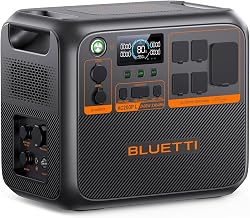
768 Wh in a 16.6 lb chassis. Fits under RV cabinets, weighs less than a car battery, and charges phones/laptops for days. 1000W AC inverter handles most small appliances but not high-draw loads. LiFePO₄, 10-year warranty per manufacturer specs. Ideal for minimalist campers or as a secondary backup unit.
Weakness: Limited capacity for extended boondocking or AC use.
Fast-Solar Specialist: Anker 757 PowerHouse
1229 Wh with an 80% solar recharge in ~1 hour (per Anker specs and YouTube teardowns). Excellent for cloudy-climate boondocking where you need fast charge cycles. 1500W AC inverter, dual USB-C with 100W fast charging, and LiFePO₄. Weighs 33 lbs. Strong Amazon owner reviews cite durability and consistent solar performance.
Weakness: Slightly pricier than Jackery equivalents; fewer AC outlets.
Budget Entry Point: Jackery Explorer 240
240 Wh, 6.3 lbs, and budget-tier pricing. Perfect for testing power needs before committing to a larger station. Runs phones, laptops, and LED lights for 1–2 days. No AC inverter—12V DC and USB only. LiFePO₄.
Weakness: Too small for serious boondocking; no AC power.
For a deeper dive on model comparisons, see Best Portable Power Stations for RVs: Boondocking & Off-Grid Guide.
Building a Complete RV Boondocking Power System
A portable power station is one piece of a larger puzzle. Here’s what a complete setup looks like:
- Power station: 1000–1500 Wh (your “battery bank”)
- Solar panels: 400–600W array (recharges the battery)
- Charge controller: Usually built into the power station; verify MPPT support
- Mounting hardware: Roof rack or portable stand (depends on your RV type)
- Cables and connectors: Match your solar input type (XT90, MC4, Anderson)
- Backup inverter (optional): A 2000W pure-sine inverter for AC loads if your power station’s inverter feels limiting
Most RV boondockers start with a mid-tier power station (1000 Wh) and add solar panels in year two, once they understand their actual power consumption.
See Best Solar Setup for RV Camping: Panels, Controllers & Batteries for a complete system walkthrough.
Runtime Expectations in Real Boondocking Scenarios
Scenario 1: Weekend trip, moderate use - Power station: 1000 Wh - Usable capacity: 750 Wh (75% of rated, accounting for depth-of-discharge and inverter losses) - Load: 12V fridge, LED lights, water pump, phone charging - Daily draw: ~80 Wh - Runtime: 9–10 days without solar
Scenario 2: Week-long boondocking with occasional AC use - Power station: 1000 Wh + 400W solar - Load: Fridge, lights, water pump, one hour of space heater per day - Daily draw: ~200 Wh - Solar recharge: ~300 Wh/day (cloudy-day average) - Runtime: Indefinite (solar covers daily draw)
Scenario 3: Cold-weather camping (below 32°F) - Power station: 1000 Wh (effective 600–700 Wh in cold per manufacturer specs) - Load: Fridge, lights, water pump, 2 hours of space heater - Daily draw: ~400 Wh - Runtime: 1.5–2 days without solar; solar output drops 30–50%
Cold-weather boondocking requires either a larger station, aggressive solar, or acceptance of limited heater runtime.
Maintenance and Longevity
LiFePO₄ stations last 10+ years if properly maintained:
- Store at 30–50% charge during off-season (per manufacturer guidance). Don’t leave fully charged or depleted.
- Avoid extreme heat. Keep below 140°F; mount in shade or use a protective cover.
- Use regularly. Monthly discharge/recharge cycles keep chemistry healthy.
- Monitor firmware updates. Many units receive efficiency improvements via app updates.
Most manufacturers offer 5–10 year warranties on LiFePO₄ units. Per owner reports on r/RVLiving, stations routinely reach 3000+ charge cycles (8–10 years of daily use) before capacity drops below 80%.
Portable Power Station vs. Gas Generator
Gas generators are cheaper upfront but cost more to operate and own over time. See Portable Power Station vs Gas Generator: Which Backup Power Wins? for a detailed comparison. For RV boondocking specifically: portable stations win on noise, fume safety, and solar integration. Generators win only on unlimited runtime (refuel anytime) and extreme cold tolerance.
FAQ
Q: What’s the difference between MPPT and PWM solar charge controllers? A: MPPT (Maximum Power Point Tracking) controllers extract 20–30% more power from solar panels than PWM (Pulse Width Modulation) controllers by continuously adjusting voltage. Most modern portable power stations use MPPT. PWM is cheaper but wastes energy as heat. For RV boondocking, MPPT is worth the cost.
Q: Can I use two power stations in parallel? A: Some units support daisy-chaining (Jackery Explorer models, EcoFlow Delta Pro). Others don’t. Check your model’s manual. Parallel connection doubles capacity and runtime but requires matching units and compatible connectors. Not all brands allow this.
Q: Will my power station work in freezing weather? A: Yes, but at reduced capacity. Most LiFePO₄ units lose 20–40% usable capacity below 32°F per manufacturer specs (Jackery, EcoFlow, Bluetti datasheets). Some units have built-in heaters (check specs). Store the station inside your RV at night to maintain warmth.
Q: Can I charge a power station while driving my RV? A: Yes, if your RV has a 120V inverter or high-amperage 12V output. Most portable stations accept 12V DC input at 10–20A. Charging via the RV’s alternator is slow but works for light use. Solar charging is faster and more efficient for boondocking.
Q: How long do portable power stations last? A: LiFePO₄ stations last 10+ years with proper care. Per manufacturer specs and owner reports, expect 3000+ charge cycles before capacity drops to 80%. Budget-tier ternary-lithium units last 5–7 years.
Wrapping Up: Choose Based on Your Boondocking Style
If you camp weekends only, a 500–1000 Wh station covers your needs. If you stay off-grid for a week or longer, pair 1000–1500 Wh with 400W+ of solar panels. If you need AC power for heating or cooking, budget for 2000+ Wh or a modular system like the EcoFlow Delta Pro. Start small, monitor your actual power consumption over two or three trips, then upgrade or add solar based on real data—not guesses.


